










Table of Contents
Introduction
Standing in front of a wall of nearly identical-looking gadgets, or scrolling through fifty tabs of “best budget headphones” comparisons, most people eventually make a decision based on whichever review sounded most confident — not necessarily whichever product actually fit their needs. That’s the gap between being a casual buyer and being a genuine gadget shopper: someone who evaluates a purchase deliberately instead of reactively.
This guide breaks down what it actually means to shop smart in the gadget space, the questions worth asking before any tech purchase, and the recurring mistakes that quietly waste money even on seemingly “good deals.”
What Makes Someone a Smart Gadget Shopper?
A smart gadget shopper isn’t defined by spending more or less money — it’s defined by how deliberately a purchase decision gets made. Rather than buying based on marketing hype, release-day excitement, or a flashy spec sheet, a thoughtful gadget shopper starts with an actual need and works backward toward the right product.
Reactive Buying vs. Deliberate Buying
Reactive buying happens when a gadget shopper sees an ad, a trending video, or a limited-time deal and buys on impulse. Deliberate buying starts with a specific problem — slow laptop, poor audio quality, inefficient home setup — and treats the gadget as a solution to that problem rather than a purchase for its own sake.
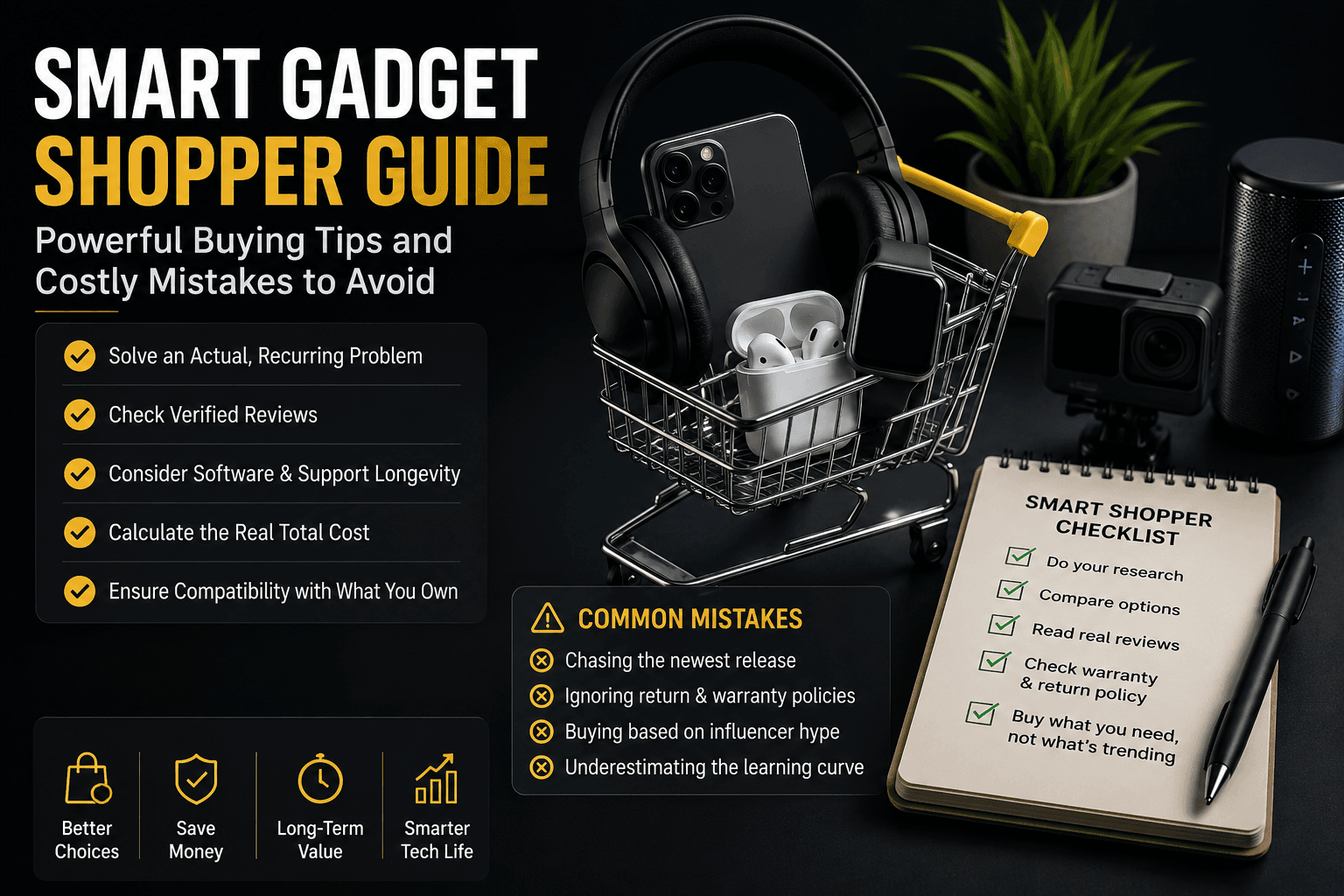
What Every Gadget Shopper Should Check Before Buying
A handful of practical checks separate a satisfying purchase from a regretted one.
Does It Solve an Actual, Recurring Problem?
The strongest purchases for any gadget shopper address something that comes up repeatedly, not a rare, one-off inconvenience. Frequency of use is usually the clearest predictor of whether a gadget earns back its cost.
What Do Verified Reviews Actually Say?
A careful gadget shopper looks past the star rating and reads specific complaints, particularly ones that repeat across multiple reviewers, since isolated complaints are often less meaningful than a consistent pattern of the same issue.
How Long Will Software and Support Last?
Devices that lose manufacturer support or software updates early become far less useful much sooner than their hardware alone would suggest, which makes checking a brand’s update track record a smart step before buying.
What’s the Real Total Cost?
An experienced gadget shopper factors in accessories, subscriptions, and replacement parts, since the advertised price rarely reflects what a device actually costs to own over its lifespan.
Does It Work With What You Already Own?
A gadget that requires replacing an entire existing setup to function properly adds hidden costs that aren’t obvious at checkout, quietly undermining the value of what looked like a good deal.
Common Mistakes Even Experienced Gadget Shoppers Make
A few patterns show up again and again, even among people who consider themselves careful buyers.
Chasing the newest release instead of the right fit. The latest version isn’t automatically the best choice for a specific use case, and early releases often carry higher prices and unresolved bugs.
Ignoring return and warranty policies. A gadget shopper who skips this step can end up stuck with a defective or poorly suited product with no straightforward way to fix the situation.
Buying based on influencer hype alone. Sponsored content doesn’t always disclose meaningful drawbacks, so cross-referencing independent reviews tends to paint a more accurate picture than a single glowing recommendation.
Underestimating the learning curve. Some gadgets promise convenience but require significant setup time or a steep learning curve that isn’t obvious from marketing materials alone.
Smart Gadget Shopper Checklist: Pros and Cons of Deliberate Buying
| Pros | Cons |
|---|---|
| Reduces buyer’s remorse and unnecessary spending | Takes more time upfront than impulse buying |
| Leads to gadgets that get used consistently | Requires comparing multiple products and reviews |
| Better long-term value through informed choices | Can mean missing short-term flash sales while researching |
| Builds a more cohesive, compatible tech setup over time | Occasionally means paying more for a genuinely better fit |
Where to Focus as a Gadget Shopper: Personal vs. Business Needs
The right approach shifts depending on who the purchase is actually for.
Personal and Everyday Purchases
For individual use, a gadget shopper generally benefits from prioritizing daily comfort and reliability — noise-cancelling headphones for a long commute, a durable phone case, or a reliable charger — over impressive but rarely-used features.
Business and Startup Purchases
For founders and small teams, the calculation shifts toward return on investment rather than personal preference alone. This same evaluation mindset — weighing whether specialized tools genuinely earn their cost — applies well beyond consumer gadgets too, as covered in our breakdowns of purpose-built software like VBOX software and Duck Creek Technologies, where understanding exactly what a tool is built for makes the buying decision far clearer.
How to Build a Repeatable Gadget-Shopping Process
Rather than starting from scratch with every purchase, a consistent process makes decisions faster and more reliable over time.
Define the problem before browsing. Knowing exactly what a gadget needs to solve prevents getting distracted by unrelated features during research.
Set a realistic budget range, not just a ceiling. A minimum viable budget helps avoid both overspending and choosing something so cheap it fails to solve the actual problem.
Compare at least three options before deciding. A quick comparison across a few alternatives tends to reveal tradeoffs that aren’t obvious when looking at a single product in isolation.
Check reviews from multiple sources. Combining user reviews, expert comparisons, and community discussions gives a more balanced picture than relying on any single source alone.
Red Flags Every Gadget Shopper Should Watch For
A few warning signs consistently show up before a purchase turns into a regret.
Reviews that all sound suspiciously similar. A cluster of near-identical five-star reviews posted around the same time is a common sign of incentivized or fake feedback rather than genuine customer experience.
Vague or missing technical specifications. Listings that avoid specific details — battery life, materials, exact compatibility — often do so because the actual numbers wouldn’t hold up well against competitors.
Pressure tactics like countdown timers on every visit. A gadget shopper who notices the same “limited time” urgency appearing on repeat visits to a site is likely looking at a manufactured sense of scarcity rather than a genuine deal.
No clear return policy listed upfront. Reputable sellers make return and warranty terms easy to find; burying or omitting this information is often a sign of a less trustworthy transaction.
An unfamiliar or newly registered retailer with no track record. Before entering payment details on a site you haven’t used before, running it through a website trust checker — like this website safety report on gadgetshopper.in — takes a minute and can reveal red flags around domain age, ownership, and reported scam activity that aren’t obvious just from browsing the site itself.
Building Long-Term Value as a Gadget Shopper
The most experienced gadget shoppers tend to think beyond the individual purchase and toward how their choices fit together over time.
Prioritizing Ecosystem Compatibility
Choosing gadgets that work well together — same charging standards, compatible software, shared accessories — reduces long-term friction and clutter compared to accumulating unrelated, incompatible devices over the years.
Reassessing Old Purchases Periodically
A useful habit for any serious gadget shopper is occasionally reviewing what’s actually still in use versus what’s sitting unused in a drawer, since this reveals patterns about which types of purchases have genuinely delivered value versus which ones were driven by hype in the moment.
What’s the difference between a smart gadget shopper and someone who just buys a lot of tech? The difference is intentionality — a smart gadget shopper evaluates whether a purchase solves an actual need, while volume alone doesn’t reflect whether those purchases are actually useful or well-suited to the buyer.
Is it worth paying more for a well-reviewed gadget over a cheaper alternative? Often, yes, particularly for items used daily, since a cheaper option that breaks quickly or performs poorly frequently ends up costing more in the long run through replacements or lost time.
How can a gadget shopper avoid buyer’s remorse? Slowing down the decision, reading verified reviews for recurring complaints, and confirming the return policy before purchasing are some of the most effective ways to reduce regret after buying.
Should gadget shoppers wait for sales events before buying? It depends on urgency. If a purchase solves an ongoing problem, waiting for a sale can mean losing weeks of the benefit the gadget would have provided, so the potential savings should be weighed against that lost time.
Are extended warranties worth it for tech purchases? This varies by product and typical failure rates, but for higher-cost or complex electronics, an extended warranty can be a reasonable safeguard, especially for devices with a history of specific, known issues.
What’s the best way to research a gadget before buying? Combining professional reviews, verified customer feedback, and community forum discussions tends to surface both the strengths and the specific drawbacks that marketing materials typically don’t mention.
Final Thoughts
Being a smart gadget shopper isn’t about spending less or avoiding new technology altogether — it’s about making purchases deliberately, with a clear problem in mind and realistic expectations about cost, support, and actual daily use. Approached this way, tech spending starts to feel a lot less like chasing trends and a lot more like building a setup that genuinely earns its place.
Ready to shop smarter for your next tech purchase? Check out our breakdowns of specialized tools like VBOX software and Duck Creek Technologies for more on evaluating purpose-built technology before you buy.