


Table of Contents
Introduction
Every time a hospital pulls up a patient’s records in seconds, a bank processes a transfer across continents, or a company keeps thousands of employees connected across different time zones, the same invisible infrastructure is doing the heavy lifting. That infrastructure has a name most people use constantly without stopping to define: information technology.
This guide breaks down what information technology actually covers, how it differs from related fields like computer science, the core areas that make up modern IT work, and why it remains one of the most foundational functions inside nearly every organization today.
What Does Information Technology Actually Mean?
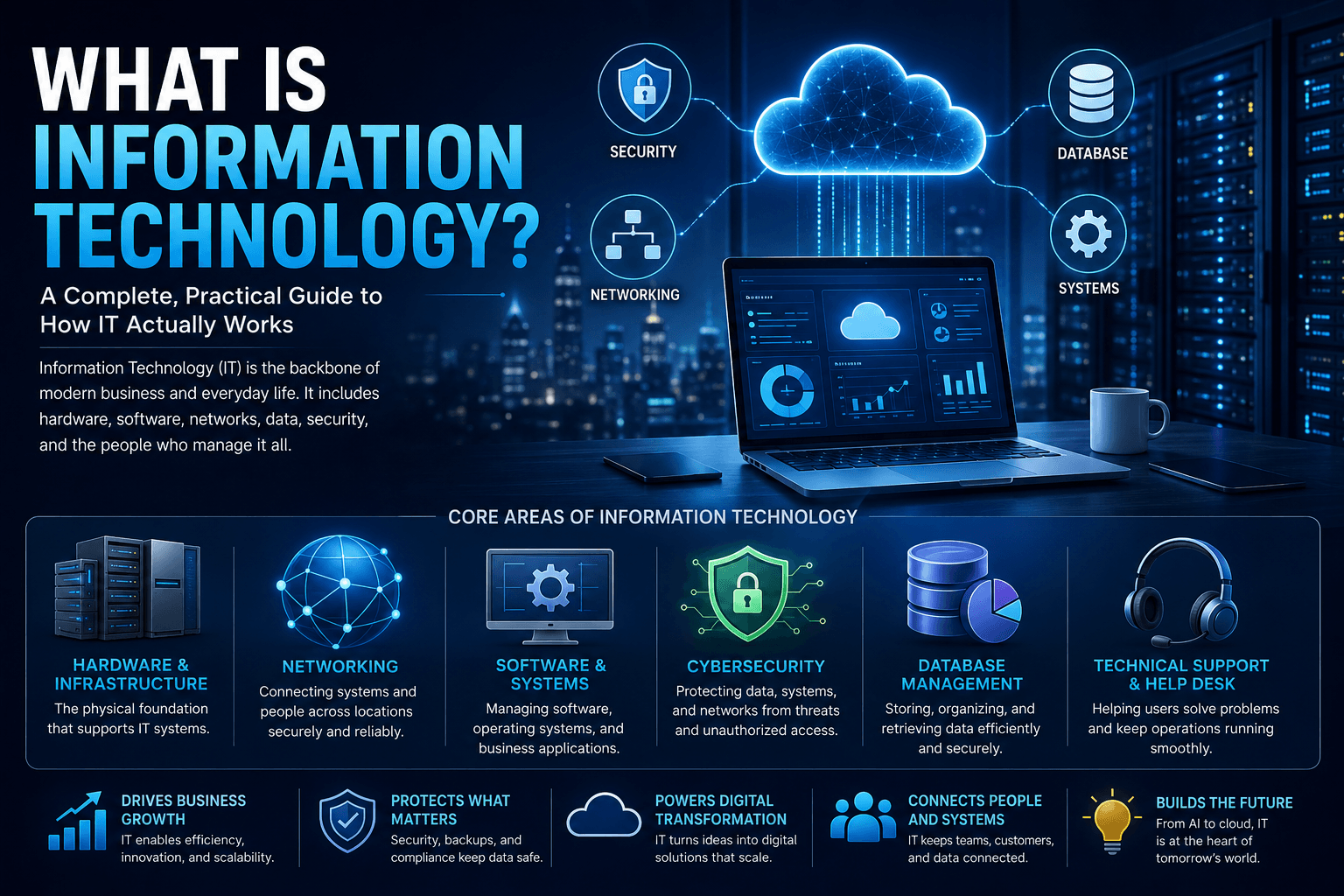
Information technology, commonly shortened to IT, refers to the use of computers, networks, storage systems, and other physical devices, infrastructure, and processes to create, process, store, secure, and exchange electronic data. It covers everything from the servers running a company’s internal systems to the help desk troubleshooting a broken laptop.
Rather than describing a single skill or job, information technology functions more like an umbrella term spanning hardware, software, networking, security, and the people who keep all of it running reliably.
Information Technology vs. Computer Science
These two fields overlap constantly but aren’t identical. Computer science tends to focus on the theoretical and mathematical foundations of computing — algorithms, data structures, programming language theory. Information technology is more applied, focused on deploying, managing, and maintaining the systems that businesses and individuals actually rely on day to day.
The Core Areas That Make Up Information Technology
Modern IT work generally breaks down into several interconnected specializations, each addressing a different piece of an organization’s technology needs.
Hardware and Infrastructure
This covers the physical foundation — servers, networking equipment, data centers, and end-user devices. Even as more computing shifts to the cloud, someone still has to manage the underlying physical or virtual infrastructure that everything else depends on.
Networking
Networking professionals within information technology focus on how systems communicate — designing and maintaining the connections that let data move reliably between devices, offices, and data centers, whether that’s a small office network or a globally distributed corporate infrastructure.
Software and Systems Administration
This area covers installing, configuring, and maintaining the software and operating systems an organization depends on, along with the ongoing work of applying updates, managing licenses, and keeping systems running smoothly.
Cybersecurity
As data breaches and cyberattacks have become more common and costly, cybersecurity has grown into one of the most critical areas within information technology, focused on protecting systems and data from unauthorized access, corruption, or theft.
Database Management
Organizations generate enormous amounts of data, and this area of IT focuses on organizing, storing, and retrieving that data efficiently and securely, often forming the backbone that other business systems depend on to function.
Technical Support and Help Desk
This is often the most visible face of information technology within an organization — the team troubleshooting everyday issues, from password resets to hardware failures, keeping employees productive when something breaks.
How Information Technology Differs Across Industries
While the core principles stay consistent, the specific priorities within information technology shift significantly depending on the industry.
Healthcare IT
Healthcare organizations rely on information technology to manage electronic health records, ensure regulatory compliance, and protect extremely sensitive patient data, often under stricter security and privacy requirements than most other industries face.
Financial Services IT
Banks and financial institutions depend on IT systems capable of processing enormous transaction volumes with near-zero downtime, while meeting strict regulatory and fraud-prevention requirements that shape nearly every architectural decision.
Retail and E-Commerce IT
For retailers, information technology increasingly centers on inventory systems, payment processing, and the digital infrastructure supporting online sales, particularly during high-traffic periods where system reliability directly affects revenue.
Why Information Technology Matters More Than Ever
A few forces explain why IT has become such a central function inside virtually every modern organization.
Business Operations Depend on Uninterrupted Systems
Downtime isn’t just an inconvenience anymore — for many organizations, even brief system outages translate directly into lost revenue, disrupted operations, or damaged customer trust, making reliable IT infrastructure a genuine business priority rather than a background function.
Data Has Become a Core Business Asset
Organizations increasingly treat data as one of their most valuable assets, which places information technology at the center of decisions around how that data gets collected, protected, analyzed, and used to guide business strategy.
Remote and Hybrid Work Increased IT’s Scope
The shift toward remote and hybrid work significantly expanded what IT teams are responsible for, from securing devices outside a traditional office network to supporting collaboration tools that didn’t carry nearly the same weight a decade ago.
Common Career Paths Within Information Technology
For anyone exploring the field, a few common entry points and specializations tend to come up repeatedly.
Help desk and technical support often serves as an entry point into IT, providing broad exposure to different systems before specializing further.
Network administration focuses specifically on designing, maintaining, and troubleshooting the connections that keep systems communicating reliably.
Systems administration centers on managing servers, operating systems, and the software infrastructure an organization depends on daily.
Cybersecurity roles have grown substantially as organizations prioritize protecting systems and data from an increasingly sophisticated threat landscape.
Cloud computing specializations have become increasingly central as organizations shift infrastructure away from on-premises hardware toward cloud-based platforms.
Information Technology: Common Misconceptions
A few misunderstandings about the field persist even among people who interact with IT regularly.
“IT is just fixing computers.” While technical support is one visible piece, information technology spans infrastructure design, security strategy, data management, and far more than day-to-day troubleshooting.
“Moving to the cloud eliminates the need for IT staff.” Cloud adoption shifts responsibilities rather than eliminating them — someone still needs to manage configurations, security, costs, and integration between cloud and existing systems.
“IT and software development are the same thing.” Development focuses on building applications, while IT more broadly covers deploying, securing, and maintaining the infrastructure and systems those applications run on.
Key Skills Valued in Information Technology Roles
Regardless of specialization, a handful of skills tend to matter across nearly every corner of the field.
Technical Problem-Solving
Most IT work ultimately comes down to diagnosing why something isn’t working as expected, then methodically narrowing down the cause — a skill that transfers across hardware, software, and network troubleshooting alike.
Adaptability to Changing Technology
Information technology evolves quickly, and professionals who stay comfortable learning new tools, platforms, and security practices tend to remain far more effective than those relying solely on skills learned early in their career.
Communication With Non-Technical Stakeholders
A significant part of IT work involves explaining technical issues and tradeoffs to people without a technical background, making clear communication just as valuable as raw technical knowledge in many roles.
Security Awareness
Even outside dedicated cybersecurity roles, a baseline understanding of security best practices has become essential across nearly every area of information technology, given how often vulnerabilities originate from everyday configuration or process gaps rather than sophisticated attacks alone.
What’s the difference between information technology and information systems? Information technology generally refers to the infrastructure and technical systems themselves, while information systems often refers more broadly to how technology, people, and processes work together to support organizational decision-making.
Do I need a computer science degree to work in information technology? Not necessarily. Many IT roles, particularly in support, networking, and systems administration, value hands-on experience and certifications alongside or instead of a traditional computer science degree.
What industries rely most heavily on information technology? While virtually every modern industry depends on IT to some degree, sectors like healthcare, financial services, and e-commerce tend to have particularly complex and mission-critical IT requirements.
How is artificial intelligence changing information technology? AI is increasingly being integrated into IT operations for tasks like automated threat detection, predictive system maintenance, and streamlining routine support requests, shifting some traditional IT responsibilities toward oversight of these automated systems.
What’s the difference between IT support and IT infrastructure roles? IT support typically focuses on resolving day-to-day user issues, while infrastructure roles focus on designing, building, and maintaining the underlying systems and networks that support an entire organization.
Is a career in information technology still a good option today? Demand for IT skills remains strong across most industries, particularly in areas like cybersecurity and cloud computing, though the specific skills in demand continue shifting as technology evolves.
Final Thoughts
Information technology has quietly become one of the most foundational functions inside modern organizations, even though most of its work stays invisible until something breaks. From the servers processing transactions to the security systems protecting sensitive data, IT touches nearly every part of how businesses operate today. Understanding its core areas — infrastructure, networking, security, and support — makes it much easier to see why this field continues to matter as much as it does, regardless of industry or company size.