










Table of Contents
Introduction
Long before neural networks dominated conversations about AI, researchers were wrestling with a much older question: how do you actually get a machine to represent something as ordinary as “a birthday party” or “a restaurant visit” in a way that captures all the unstated assumptions a human brings to that idea without thinking twice? Frames were one of the earliest, most influential answers to that question, and the ideas behind them still echo through how modern systems organize knowledge today.
This guide breaks down what frames in frames in artificial intelligence actually are, who introduced the concept, how frame-based systems work in practice, and why the idea still matters even in an era dominated by very different AI techniques.
What Are Frames in Artificial Intelligence?
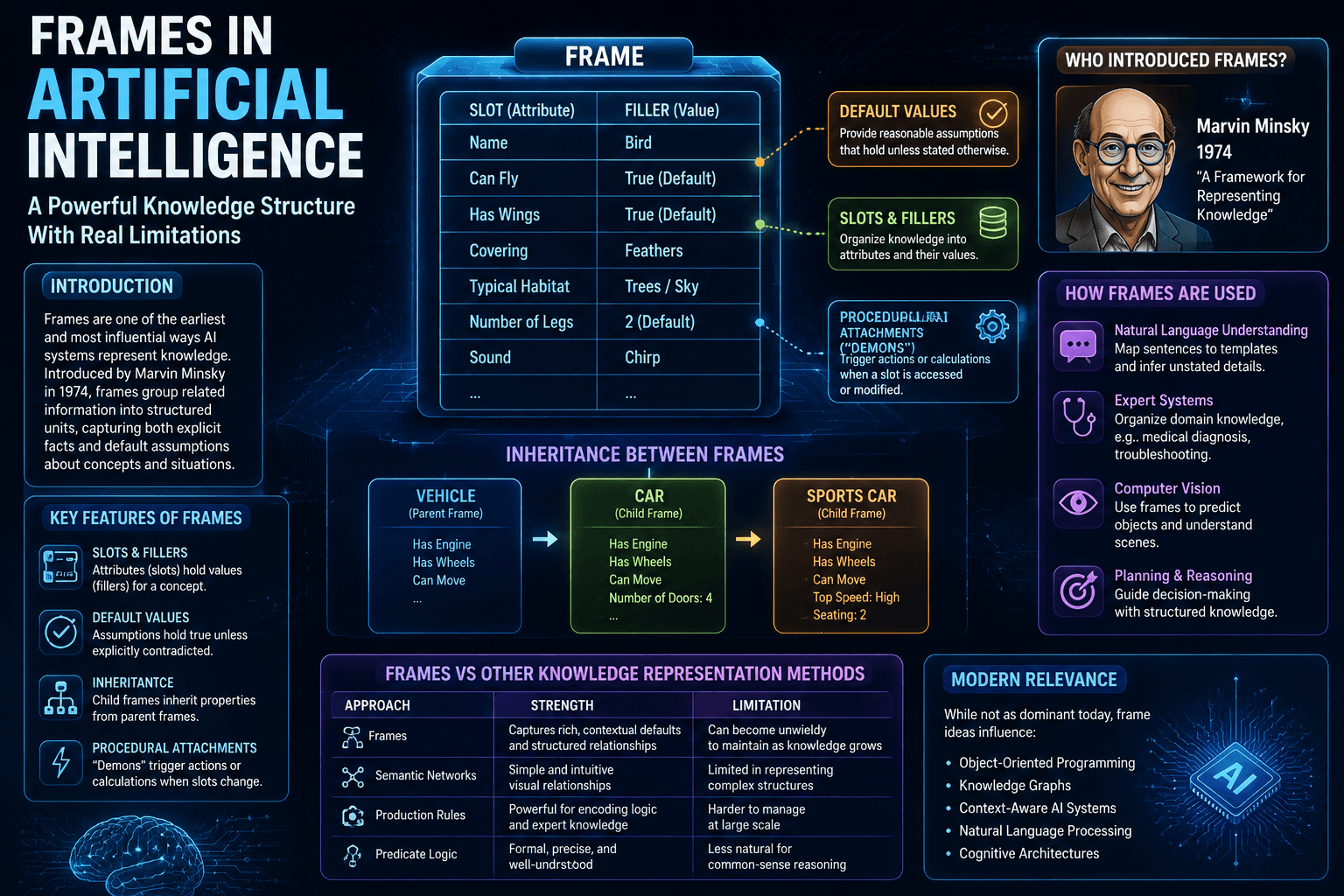
A frame is a data structure used to represent a stereotyped situation, object, or concept, bundling together the typical properties, expected relationships, and default assumptions associated with that concept into a single, organized unit. Rather than storing isolated facts, frames group related information the way a mental “template” might, capturing not just what’s explicitly known but what can reasonably be assumed unless stated otherwise.
The concept was introduced by frames in artificial intelligence pioneer Marvin Minsky in his 1974 paper “A Framework for Representing Knowledge,” where he argued that human understanding relies heavily on these kinds of pre-packaged mental structures, and that AI systems attempting to reason about the world would benefit from a similar organizational approach.
Why Minsky Proposed Frames
Minsky’s core observation was that earlier knowledge representation approaches, built primarily around isolated logical statements, struggled to capture the rich, contextual assumptions humans bring to everyday situations. A frame representing “a room,” for instance, doesn’t need to be told explicitly that rooms typically have walls, a floor, and a ceiling — those expectations come built in, ready to be overridden only when a specific case genuinely differs from the default.
The Structure of a Frame
Understanding how a frame is actually built helps clarify why this approach differs meaningfully from simpler knowledge representation methods.
Slots and Fillers
Each frame consists of slots, representing specific attributes or properties of the concept being modeled, and fillers, which hold the actual values for those attributes. A frame representing “car,” for example, might include slots for manufacturer, number of wheels, and fuel type, each filled with either specific known values or reasonable defaults.
Default Values
One of the more distinctive features of frames is their support for default values — assumptions that hold unless explicitly contradicted. A “bird” frame might default the “can fly” slot to true, automatically adjusting only when reasoning about a specific exception, like a penguin, that’s explicitly marked otherwise.
Inheritance Between Frames
frames in artificial intelligence can be organized hierarchically, where more specific frames inherit properties from more general parent frames. A “sports car” frame might inherit most of its structure from a broader “car” frame, only overriding the specific slots where it genuinely differs, such as top speed or seating capacity.
Procedural Attachments
Beyond static data, frames can include procedural attachments — small pieces of executable logic tied to specific slots, often triggered automatically when a value is read or modified. These are sometimes referred to as “demons,” and they allow frames to perform calculations or trigger actions rather than just storing passive data.
How Frame-Based Systems Are Used in AI
Frames found practical application across several areas of artificial intelligence research, particularly in systems built before machine learning became the dominant paradigm.
Natural Language Understanding
Early natural language processing systems used frames to interpret sentences by mapping them onto pre-built templates representing common situations, helping a system infer unstated details based on the type of event being described, such as recognizing that a sentence about “ordering food” implicitly involves a customer, a menu, and payment.
Expert Systems
Many rule-based expert systems from the 1970s and 1980s relied on frames to organize domain knowledge, particularly in fields like medical diagnosis, where representing typical disease profiles with expected symptoms and known exceptions mapped naturally onto a frame-based structure.
Computer Vision and Scene Understanding
Frames were also applied to visual scene interpretation, where a system might use a “kitchen” frame to generate reasonable default expectations about what objects are likely present, helping guide object recognition even when parts of a scene are ambiguous or partially obscured.
Frames vs. Other Knowledge Representation Methods
| Approach | Strength | Limitation |
|---|---|---|
| Frames | Captures rich, contextual defaults and structured relationships | Can become unwieldy to maintain as knowledge grows |
| Semantic Networks | Simple, intuitive graph-based relationships | Less structured support for default reasoning |
| Production Rules | Clear, explicit if-then logic | Struggles to represent complex, interrelated context |
| Predicate Logic | Precise, formally verifiable reasoning | Doesn’t naturally handle default assumptions or exceptions |
Why Frames Eventually Fell Out of Mainstream Use
Despite their influence, frame-based systems aren’t the dominant approach in most modern AI applications, and understanding why helps place the concept in proper historical context.
The Knowledge Engineering Bottleneck
Building comprehensive frame systems required extensive manual effort from human experts to define slots, defaults, and exceptions for every relevant concept, a process that became increasingly impractical as the scope of required knowledge grew.
The Rise of Statistical and Machine Learning Approaches
Modern frames in artificial intelligence systems, particularly those built on neural networks, learn patterns directly from large datasets rather than relying on manually engineered structures, sidestepping much of the labor-intensive knowledge engineering that frame-based systems demanded.
Difficulty Handling True Novelty
Frames work well for situations resembling pre-defined templates but struggle when a system encounters something that doesn’t cleanly fit any existing frame, a limitation that became more apparent as AI applications expanded into increasingly open-ended, unpredictable domains.
Why Frames Still Matter Today
Even outside dedicated frame-based systems, the underlying ideas have quietly persisted across modern AI and computer science more broadly.
Object-Oriented Programming Owes a Debt to Frames
The concepts of inheritance, default values, and structured attributes that define object-oriented programming languages closely mirror ideas Minsky formalized in frame theory decades earlier, even though most developers using these languages today rarely make that connection explicit.
Structured Knowledge in Modern AI Systems
Contemporary knowledge graphs and ontologies, used extensively in search engines and enterprise data systems, echo core frame concepts — organizing entities with defined properties and hierarchical relationships — even as the underlying implementation technology has evolved considerably.
Common Misconceptions About Frames in Artificial Intelligence
A few misunderstandings tend to follow this concept, particularly among people encountering it for the first time outside a formal AI course.
“Frames are the same thing as databases.” While both organize structured information, frames specifically emphasize default values, inheritance, and procedural attachments — features not native to standard database records, which typically store only explicit, static values.
“Frames in artificial intelligence are outdated and irrelevant.” While dedicated frame-based systems have declined, the structural thinking behind frames in frames in artificial intelligence directly influenced how later technologies, including object-oriented programming and knowledge graphs, organize information.
“Frame theory only applies to language processing.” Though natural language understanding was a major early application, frames in artificial intelligence were applied just as extensively to expert systems and visual scene interpretation, spanning a much broader range of problems than language alone.
Learning Frame Theory: Where the Concept Fits in AI Education
For students or professionals studying the history of frames in artificial intelligence typically appear alongside other classical knowledge representation techniques as part of understanding how AI approached reasoning before the shift toward statistical and machine learning methods. Understanding frames in artificial intelligence provides useful context for why certain design patterns in modern software — inheritance hierarchies, default configurations, structured schemas — look the way they do, even in systems that have nothing to do with AI research directly.
Who invented the concept of frames in artificial intelligence? Marvin Minsky introduced frames in his 1974 paper “A Framework for Representing Knowledge,” proposing them as a way to represent stereotyped situations and objects with their typical properties and default assumptions.
What’s the difference between a frame and a semantic network? Frames in artificial intelligence bundle multiple related properties, defaults, and procedural behavior into a single structured unit, while semantic networks primarily represent relationships between concepts as a graph of connected nodes without the same emphasis on default values and inheritance.
Are frames still used in modern AI systems? Dedicated frame-based systems are far less common today, largely replaced by machine learning approaches, though the core ideas behind frames in artificial intelligence default values, inheritance, and structured attributes — persist in areas like object-oriented programming and knowledge graphs.
What is a “slot” in a frame? A slot represents a specific attribute or property within a frame, such as color or size, which gets filled with either a specific known value or a reasonable default when no specific information is available.
Why did frame-based systems become less popular over time? The manual effort required to build and maintain comprehensive frame structures became impractical at scale, and machine learning approaches that learn directly from data largely replaced the need for hand-engineered knowledge structures in most modern applications.
How do frames relate to object-oriented programming? Object-oriented programming’s use of classes, inheritance, and default attribute values closely parallels core ideas from frame theory, even though object-oriented languages were developed and popularized somewhat independently of AI research.
Final Thoughts
Frames represent one of the more influential ideas to emerge from early frames in artificial intelligence research, offering a structured way to bundle typical properties, defaults, and relationships into a single, organized concept. While dedicated frame-based systems have largely given way to machine learning approaches better suited to handling messy, real-world data at scale, the underlying logic behind frames in artificial intelligence — structured attributes, inheritance, and default reasoning — continues to shape how modern systems, from programming languages to knowledge graphs, organize information today.