





Table of Contents
Introduction
A university lab hires a brilliant graduate researcher who happens to be a foreign national. A defense contractor brings on a new engineer who needs access to sensitive technical drawings. A tech company starts sharing product specs with an overseas partner. In every one of these situations, U.S. export control law can turn what looks like routine business into a legal risk — and a technology control plan is the document organizations use to manage that risk properly.
This guide breaks down what a technology control plan actually is, when one is legally required, what it needs to include, and why getting this wrong can carry consequences far more serious than most people realize.
What Is a Technology Control Plan?
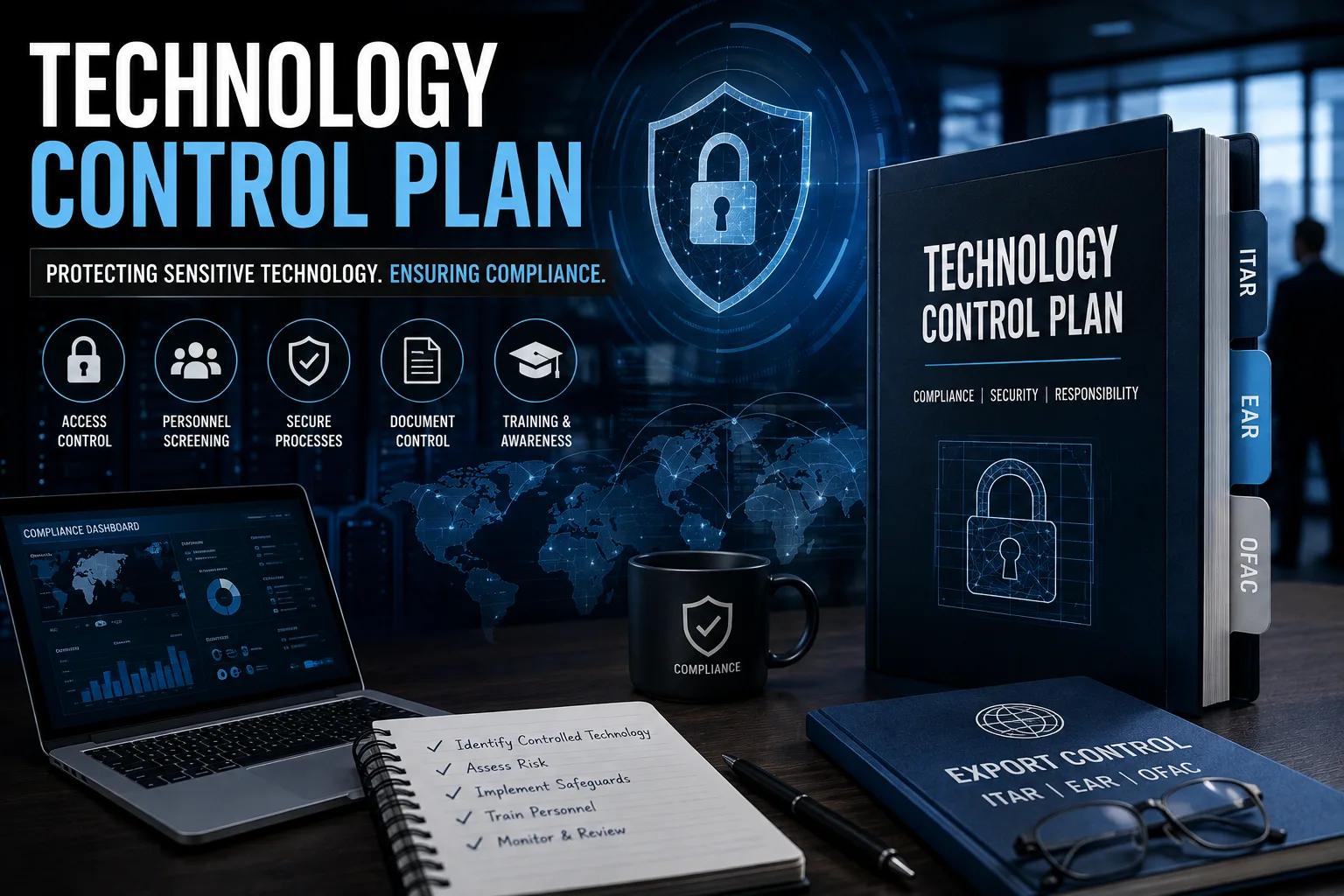
A technology control plan, commonly abbreviated as TCP, is a formal document that outlines how an organization will protect export-controlled technology, technical data, software, or materials from unauthorized access, disclosure, or export. It translates U.S. export control law into specific, day-to-day procedures that employees and project personnel actually follow.
TCPs exist to help organizations comply with a specific set of federal regulations: the International Traffic in Arms Regulations (ITAR), the Export Administration Regulations (EAR), and in some cases requirements from the Office of Foreign Assets Control (OFAC). These regulations exist to prevent sensitive technology from reaching people or countries that could use it in ways that threaten U.S. national security or economic interests.
The “Deemed Export” Rule You Need to Understand
One of the most important — and most commonly misunderstood — aspects of export control law is the “deemed export” rule. Under both ITAR and EAR, simply showing controlled technical data or information to a foreign national physically present in the United States counts as an export to that person’s home country, even if nothing physically crosses a border. This is exactly why a technology control plan often becomes necessary the moment a foreign national employee, contractor, or student gains access to controlled information, not just when something gets shipped overseas.
When Is a Technology Control Plan Required?
Not every organization needs a formal TCP, but certain situations make one effectively mandatory.
Handling ITAR or EAR-Controlled Technology
If an organization works with technology, technical data, or software that falls under the U.S. Munitions List (ITAR) or is subject to export licensing requirements under the EAR, a technology control plan is typically required to demonstrate a functioning compliance program, regardless of whether the work is government-funded or privately sponsored.
Employing or Hosting Foreign Nationals
Universities, research institutions, and defense contractors that employ or host foreign national employees, students, or visiting researchers frequently need a technology control plan specifically to manage deemed export risk, ensuring controlled information stays restricted to authorized personnel.
Working With International Partners or Suppliers
Companies sharing technical specifications, designs, or software with overseas partners, suppliers, or customers need to confirm whether that information is export-controlled, and if so, implement a TCP governing exactly how that information gets shared and protected.
Core Elements of a Technology Control Plan
While specific requirements vary by organization and the type of controlled technology involved, most technology control plans address a consistent set of core components.
Identification of Controlled Technology
A TCP needs to clearly classify and label exactly which technology, data, or materials fall under export control, often referencing the specific ITAR category or EAR Export Control Classification Number (ECCN) that applies.
Access Control and Need-to-Know Restrictions
Role-based access controls, both physical and digital, restrict controlled information to specifically authorized personnel, enforcing a need-to-know principle rather than broad, organization-wide access.
Personnel Screening and Training
A technology control plan typically requires identifying which personnel are foreign nationals subject to deemed export restrictions, along with documented training ensuring everyone involved understands their specific compliance obligations.
Physical and Information Security Measures
This includes securing physical spaces where controlled technology is stored or discussed, along with digital safeguards like restricted network access, controlling how information moves both within and outside the organization.
Document Handling and Destruction Procedures
Clear procedures for how controlled documents and data get stored, transferred, and eventually destroyed help prevent accidental disclosure long after a project’s active phase has ended.
Technology Control Plan: Pros and Cons
| Pros | Cons |
|---|---|
| Provides a clear, defensible compliance framework | Requires ongoing maintenance as personnel and projects change |
| Reduces risk of costly civil or criminal export violations | Can slow down collaboration with foreign colleagues or partners |
| Demonstrates good-faith compliance effort to regulators | Requires dedicated staff time to properly implement and monitor |
| Helps organizations qualify for sensitive government contracts | Complexity increases significantly with multiple simultaneous projects |
What Happens Without a Proper Technology Control Plan?
The stakes here are genuinely serious, which is part of why this topic generates so much institutional attention.
Civil and Criminal Penalties
Export control violations under ITAR and EAR can result in substantial civil penalties, and in more serious cases, criminal penalties including significant fines and potential prison time for individuals found responsible for willful violations.
Loss of Export Privileges
Organizations found in violation can face suspension or revocation of their export privileges entirely, which for defense contractors and technology companies with international operations can be functionally devastating to their business.
Reputational and Contract Risk
Beyond direct penalties, a documented compliance failure can jeopardize eligibility for future government contracts and damage relationships with partners who require demonstrated export compliance as a condition of doing business.
Common Mistakes Organizations Make With Technology Control Plans
A handful of recurring issues show up even among organizations that take compliance seriously.
Treating the TCP as a one-time document. Personnel change, projects evolve, and technology gets reclassified. A TCP that isn’t actively updated as circumstances change quickly becomes inaccurate and far less protective than it appears.
Failing to train all relevant personnel, not just direct project leads. Export control obligations extend to anyone with potential access to controlled information, including support staff, IT personnel, and facilities teams who are sometimes overlooked in training rollouts.
Assuming a project is exempt without formal classification. Determining whether a specific technology is actually export-controlled requires a proper classification review, not an informal assumption, since misclassification carries real legal exposure.
Underestimating deemed export risk. Many organizations focus primarily on physical shipments overseas while overlooking that simply granting a foreign national employee access to controlled data domestically can trigger the same regulatory obligations.
Frequently Asked Questions
Who typically needs to create a technology control plan? Universities conducting export-controlled research, defense contractors, and technology companies handling ITAR or EAR-controlled information generally need a formal TCP, particularly when foreign nationals are involved in a project.
What’s the difference between ITAR and EAR in relation to a technology control plan? ITAR governs defense-related articles and technical data under the U.S. Munitions List, while EAR covers a broader range of dual-use and commercial items with potential military applications; a TCP may need to address either framework, or sometimes both, depending on the technology involved.
Does a technology control plan apply even if nothing physically leaves the country? Yes. Under the deemed export rule, sharing controlled technical information with a foreign national physically present in the U.S. counts as an export to that person’s country, which is often the exact scenario a TCP is designed to manage.
Who is responsible for maintaining a technology control plan? This typically falls to a designated compliance officer, export control administrator, or in research settings, the Principal Investigator overseeing a specific export-controlled project, working alongside an institution’s broader export compliance office.
What happens if a technology control plan isn’t followed correctly? Violations can result in civil penalties, potential criminal liability for willful violations, and loss of export privileges, making consistent adherence to the plan just as important as having one in place.
Is legal counsel necessary when creating a technology control plan? Given the legal complexity and serious penalties involved, most organizations work with export control specialists or legal counsel to ensure a TCP accurately reflects current regulatory requirements rather than relying solely on generic templates.
Final Thoughts
A technology control plan isn’t just paperwork — it’s the practical mechanism that turns complex, high-stakes export control law into procedures real people can actually follow day to day. For any organization working with sensitive technology, foreign national personnel, or international partners, understanding when a TCP is required and what it needs to include isn’t optional due diligence; it’s a genuine safeguard against penalties that can range from costly fines to the loss of an organization’s ability to operate in sensitive industries at all.