









Table of Contents
Introduction
Anyone who’s dragged a tangle of chargers through airport security, or realized halfway through a hike that their phone died right when they needed the map most, knows exactly why travel gadgets exist. The right one quietly saves a trip. The wrong one just adds dead weight to a bag that’s already too full.
By the end of this guide, you’ll know which categories of travel gadgets are genuinely worth their weight, which ones are mostly marketing hype, how to decide what actually belongs in your bag for a specific trip, and which picks make sense depending on whether you’re heading out for business, a hike, or a family vacation.
What Actually Makes a Good Travel Gadget?
Not every gadget marketed for travel deserves the label. A good travel gadget solves a problem that specifically shows up while you’re away from home — limited outlets, unfamiliar routes, spotty connectivity — rather than just being a smaller version of something you already own.
Portability Isn’t Optional
Anything added to a travel bag has to earn its weight and space. A gadget that’s brilliant at home but bulky or fragile on the road usually gets left behind after the first trip, no matter how useful it seemed in the store.
It Should Solve a Real Travel-Specific Problem
The most useful travel gadgets address something unique to being away from your normal setup — charging multiple devices from one unfamiliar outlet, navigating without reliable data, or keeping valuables secure in an unfamiliar place.
Categories of Travel Gadgets Worth Considering
A handful of categories consistently show up in well-thought-out packing lists, each solving a genuinely common travel headache.
Power and Charging
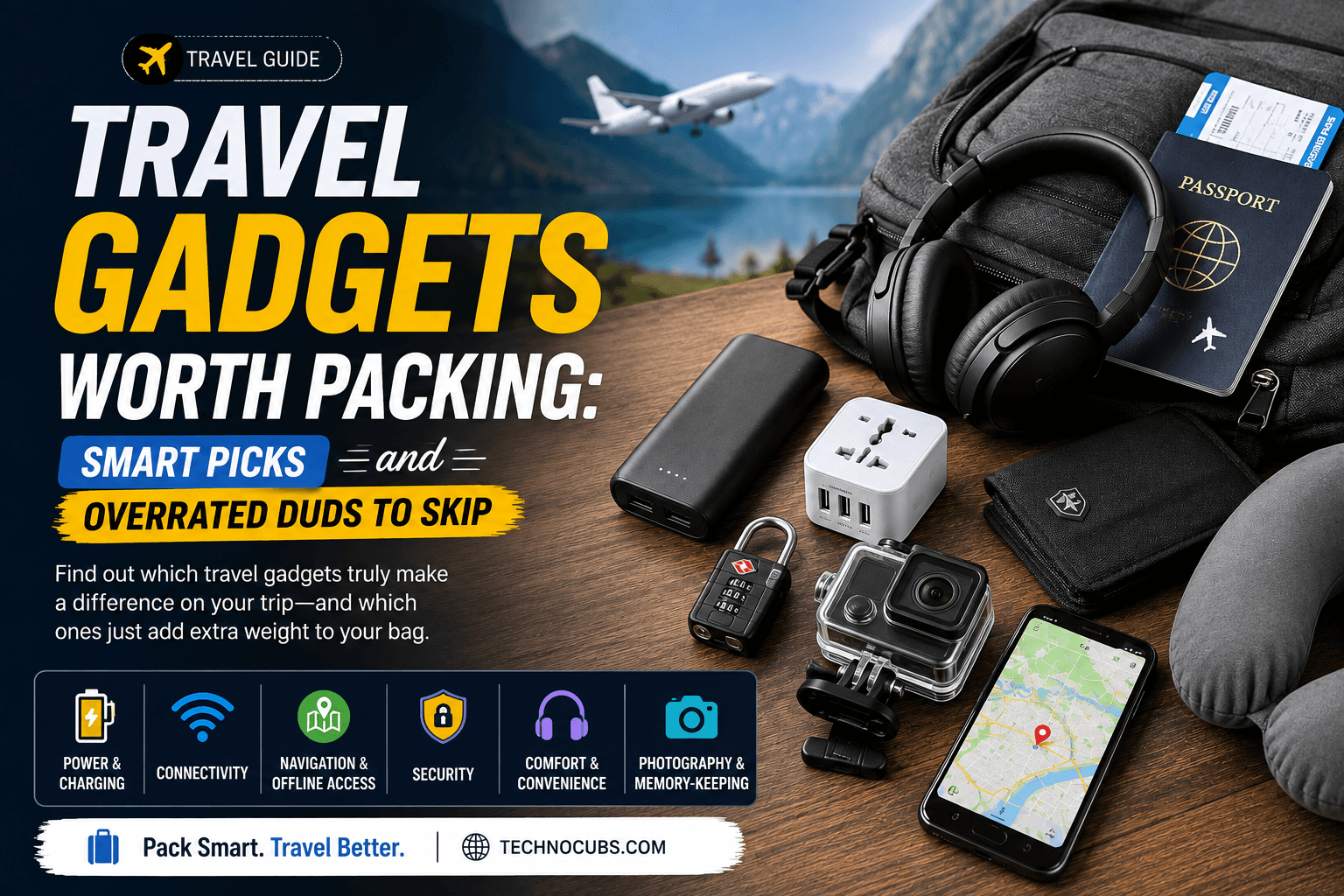
A compact portable power bank remains one of the most consistently useful travel gadgets, especially on long flights or full days of sightseeing with no outlet in sight. A universal travel adapter paired with a multi-port USB charger also solves the surprisingly common problem of one outlet, several devices, and limited time before boarding.
Connectivity
A portable Wi-Fi hotspot or a local SIM solution can matter more than almost any other travel gadget on this list, particularly for anyone relying on maps, translation apps, or ride-hailing services in an unfamiliar country where hotel Wi-Fi alone won’t cut it.
Navigation and Offline Access
Offline map downloads and GPS-based devices matter most exactly when cell service doesn’t — hiking trails, remote regions, or countries with unreliable data coverage, where a dead phone or lost signal turns a minor inconvenience into a real problem.
Security
A TSA-approved lock, an RFID-blocking wallet, or a portable door alarm fall into a category of travel gadgets that most people only appreciate after the one time they needed one and didn’t have it.
Comfort and Convenience
Noise-cancelling headphones, a compact travel pillow, or packing cubes aren’t flashy, but they consistently show up on seasoned travelers’ repeat-purchase lists because they address genuine discomfort that builds up over long trips.
Photography and Memory-Keeping
Compact action cameras and lightweight tripods let travelers capture moments without hauling professional equipment through security, striking a practical balance between quality and portability that a phone camera alone doesn’t always achieve. A small waterproof action camera in the 4K range, paired with a flexible mini tripod that clips onto railings or branches, covers most scenarios from underwater snorkeling shots to steady sunset timelapses, without the bulk of a full DSLR kit and multiple lenses.
Travel Gadgets: What’s Actually Worth It vs. What’s Overhyped
| Worth Packing | Why | Often Overhyped | Why |
|---|---|---|---|
| Portable power bank | Solves the near-universal problem of dead batteries with no outlet in sight | Smart luggage with built-in battery | Often restricted or has batteries removed by airlines before flights |
| Universal travel adapter | Works across countries without needing multiple single-purpose adapters | Single-use novelty gadgets | Narrow functionality means they get used once, then forgotten |
| Offline map / GPS device | Keeps working exactly when cell service doesn’t | Overly complex “all-in-one” gadgets | Tend to do many things poorly instead of one thing well |
| Compact security lock | Cheap insurance against a problem that’s rare but costly when it happens | High-end specialty gadgets | Often useful for only one specific trip type, then unused |
| Noise-cancelling headphones | Meaningfully reduces fatigue on long flights and layovers | Gadgets needing their own dedicated charger | Adds another cable and charging obligation to an already full bag |
Best Travel Gadgets by Trip Type
What belongs in your bag shifts significantly depending on where you’re actually going and why.
Business Trips
Connectivity and productivity take priority here — a portable Wi-Fi hotspot for reliable internet between meetings, a compact multi-port charger for keeping a laptop and phone running simultaneously, and noise-cancelling headphones for working through noisy airports and layovers.
International Trips
A universal travel adapter is close to non-negotiable, alongside offline translation tools or downloaded language packs and an offline map for navigating without relying on expensive international data plans.
Road Trips
A car-compatible power inverter or charger, an offline GPS unit as backup for areas with poor signal, and a dash cam for both documentation and peace of mind tend to matter more here than gadgets built for flying.
Hiking and Adventure Travel
Durability and battery independence matter most — a rugged, waterproof action camera, a solar charger or high-capacity power bank for multi-day trips away from outlets, and a dedicated GPS device that doesn’t depend on cell signal in remote terrain.
Family Vacations
Practicality for multiple people usually wins over specialized gear — a multi-port charging hub that covers several devices at once, kid-friendly headphones for flights and car rides, and a reliable power bank sized for a full day at a theme park or beach without needing a recharge.
A few practical questions help cut through marketing hype before buying anything new for an upcoming trip.
Will you actually use it on this specific trip? A gadget perfect for a beach vacation is often dead weight on a business trip, and being honest about the actual itinerary avoids overpacking gear that never leaves the bag.
Does it need its own charger or cable? Every additional charging requirement adds friction, so gadgets that share existing cables or charge via the same power bank tend to get used far more consistently than ones needing a dedicated charger.
Is it durable enough for actual travel conditions? Gadgets that perform well at home don’t always hold up to temperature swings, rough handling, or airport security checks, so checking real-world durability reviews matters more for travel gadgets than for items that stay at home.
Are airline restrictions a factor? Certain battery-powered travel gadgets, particularly power banks and anything with lithium batteries, are subject to airline and country-specific rules that change fairly often and vary by carrier. Rather than assuming a device is fine based on a past trip, checking the specific airline’s current guidelines shortly before departure is worth the few minutes it takes, since a confiscated device at security ruins the point of buying it in the first place.
Building a Travel Gadget Kit Without Overpacking
Rather than buying every gadget that looks appealing, a more deliberate approach tends to produce a kit that actually gets used trip after trip. This same evaluate-before-you-buy mindset applies broadly to gadget purchases in general, not just travel-specific ones — a theme covered in more depth in our guide to smart gadget shopping, which walks through how to avoid buyer’s remorse on tech purchases of any kind.
For anyone traveling for work rather than leisure, the calculation shifts slightly toward gadgets that directly support productivity on the road, an angle explored further in our breakdown of essential startup gadgets and how founders evaluate tech purchases as genuine investments rather than impulse buys, a mindset also covered in our guide to gadgets as investments.
Common Mistakes People Make With Travel Gadgets
A few recurring patterns lead to wasted money and overstuffed bags.
Buying gadgets right before a trip without testing them. A brand-new gadget with an unfamiliar interface is the last thing you want to be figuring out mid-trip, so testing anything new well before departure avoids frustration when it matters most.
Packing redundant gadgets that do the same job. Multiple devices solving the same problem — several chargers, overlapping security tools — just add weight without adding value.
Ignoring battery life in real-world conditions. Manufacturer battery estimates rarely match actual performance during heavy travel use, so building in a buffer, or packing a backup power source, tends to prevent the worst-case scenario of a dead device at the wrong moment.
Choosing style over practicality. A visually appealing gadget that doesn’t hold up to actual travel conditions ends up being the one item left behind on the next trip.
Frequently Asked Questions
What are the most essential travel gadgets for a first-time traveler? A portable power bank, a universal travel adapter, and offline maps tend to cover the most common travel headaches, making them a reasonable starting point before adding more specialized gadgets.
Are expensive travel gadgets always better than budget options? Not necessarily. Durability and how well a gadget fits your specific travel style usually matter more than price alone, and plenty of budget-friendly travel gadgets perform just as reliably as premium versions.
Can I bring power banks and other travel gadgets on a plane? Most power banks are allowed in carry-on luggage, though capacity limits and battery type restrictions vary by airline, so checking specific guidelines before a flight is worth the extra few minutes.
How many travel gadgets should I realistically pack? This depends heavily on trip type and length, but focusing on gadgets that solve a specific, likely problem tends to produce a lighter, more useful kit than trying to prepare for every possible scenario.
Do I need different travel gadgets for business trips versus vacations? Often, yes. Business travel tends to prioritize connectivity and productivity gadgets, while leisure travel often leans more toward comfort, navigation, and photography-focused gear.
What’s the biggest mistake people make when buying travel gadgets? Buying based on marketing appeal rather than an honest assessment of whether the gadget solves a problem specific to their actual travel habits and destinations.
Final Thoughts
The best travel gadgets aren’t the flashiest ones — they’re the ones that quietly solve a real problem without adding unnecessary weight or complexity to a trip. Focusing on genuine utility over marketing hype, and being honest about what a specific trip actually requires, tends to produce a travel kit that earns its place in the bag every single time rather than gathering dust after one use.