









Table of Contents
Introduction
Behind almost every modern property and casualty insurance policy — the one covering your car, your home, or a business’s commercial liability — sits a core software system quietly handling underwriting, billing, and claims. For a large share of the industry, that system runs on Duck Creek Technologies, a name that comes up constantly in insurance IT circles but remains largely unknown outside of it.
This guide breaks down what Duck Creek Technologies actually does, who uses it, how it fits into the broader insurtech landscape, and what to know before evaluating it as a potential software partner.
What Is Duck Creek Technologies?
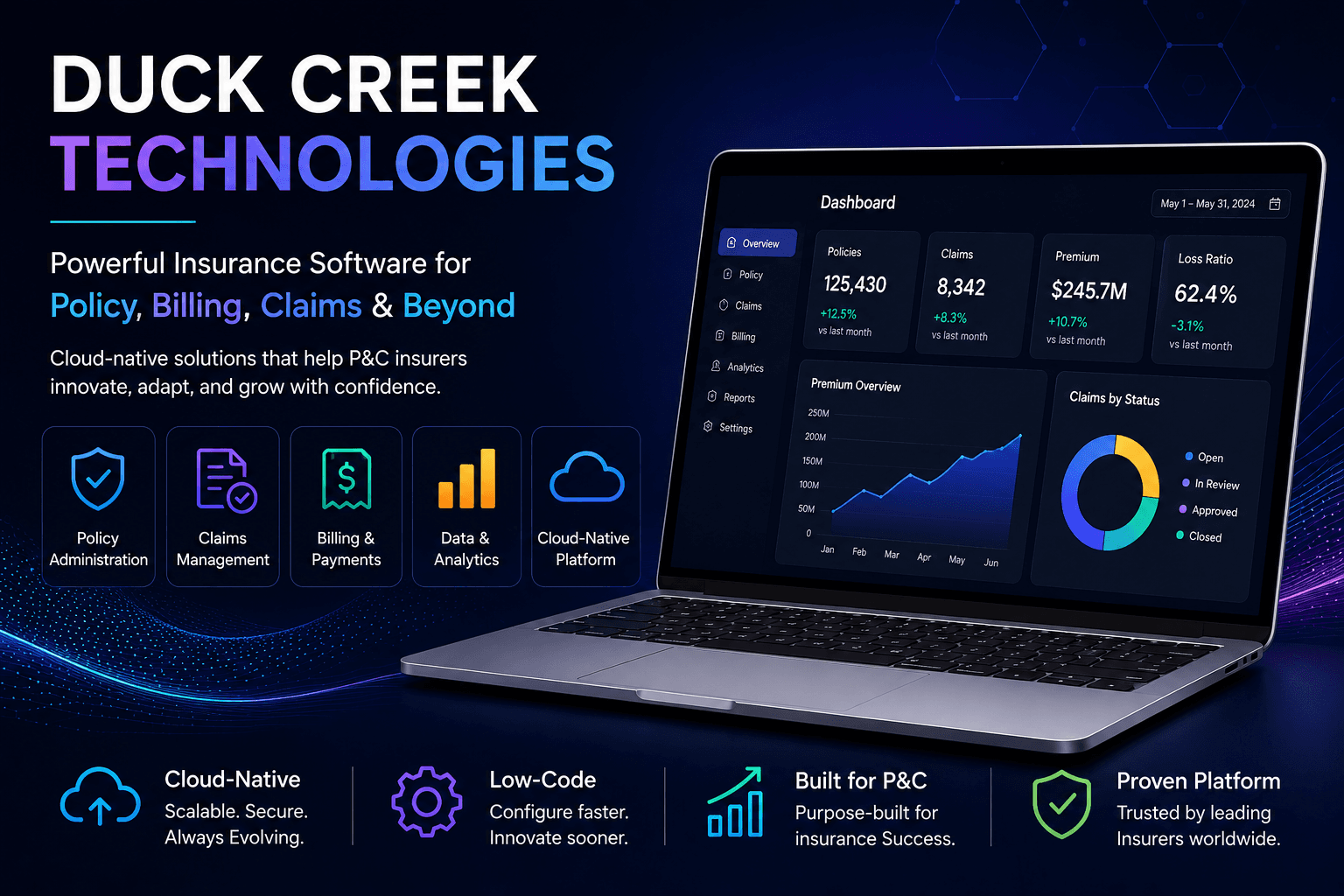
Duck Creek Technologies is a software company founded in 2000 that builds cloud-native core systems specifically for the property and casualty (P&C) insurance industry. Rather than serving general business software needs, its entire product suite is purpose-built around how P&C insurers operate — underwriting, policy administration, billing, claims, and the data and digital engagement tools that surround those core functions.
From Public Company to Private Ownership
Duck Creek Technologies traded publicly on the Nasdaq under the ticker DCT for several years before Vista Equity Partners, a private equity firm focused exclusively on enterprise software companies, acquired it in an all-cash deal completed in March 2023, valued at roughly $2.6 billion. Since that acquisition closed, Duck Creek Technologies has operated as a privately held company rather than a publicly traded one.
Core Products Offered by Duck Creek Technologies
The Duck Creek Technologies product suite is organized around the full lifecycle of an insurance policy, from initial quote through claims resolution.
Policy Administration and Rating
This forms the backbone of the platform — handling policy issuance, underwriting rules, and rating calculations, with a low-code configuration approach that lets insurers adjust products and rating logic without needing a full development cycle for every change.
Claims Management
Duck Creek Technologies’ claims module supports the entire claims lifecycle, from First Notice of Loss through investigation, payment, and closure, aiming to help insurers resolve claims faster while maintaining consistency across commercial, personal, and specialty lines of business.
Billing
The billing component handles premium collection, invoicing, and payment processing, integrating with the broader policy and claims systems so financial data stays consistent across the entire customer relationship rather than living in a separate, disconnected system.
Data and Analytics
Duck Creek Clarity, the company’s analytics offering, is built to help insurers turn operational data into actionable insight, supporting faster decision-making around pricing, risk, and operational performance.
Who Actually Uses Duck Creek Technologies?
The platform is built specifically for property and casualty insurance carriers — not general businesses, and not insurance brokers in isolation, but the carriers themselves who need to run policy administration, billing, and claims at scale.
Enterprise-Level Insurance Carriers
Given the complexity and cost typically associated with core insurance systems, Duck Creek Technologies tends to be adopted by mid-size to large P&C insurers rather than very small agencies, since the platform is designed to handle high policy volumes and complex, multi-state regulatory requirements.
Insurers Undergoing Digital Transformation
A significant portion of Duck Creek Technologies’ customer base consists of carriers modernizing away from older, legacy core systems, drawn to its cloud-native, SaaS delivery model (branded as Duck Creek OnDemand) as a way to reduce the technical debt of maintaining outdated infrastructure.
Duck Creek Technologies: Pros and Cons
| Pros | Cons |
|---|---|
| Purpose-built specifically for P&C insurance, not a generic platform adapted for the industry | Steep learning curve for teams new to the platform |
| Low-code configuration reduces dependency on custom development for routine changes | Implementation projects can be lengthy and resource-intensive |
| Cloud-native SaaS delivery reduces infrastructure maintenance burden | Pricing and licensing complexity typically requires direct vendor consultation |
| Comprehensive suite covers policy, billing, claims, and analytics in one ecosystem | Best suited to mid-size and large carriers, less practical for very small agencies |
Where Duck Creek Technologies Fits in the Insurtech Landscape
Understanding its competitive position helps clarify what makes this platform distinct from general enterprise software.
Competing Platforms
Duck Creek Technologies competes primarily with other P&C-focused core system providers, each targeting overlapping but slightly different segments of the insurance carrier market based on company size, region, and specific lines of business supported. For a detailed breakdown of the company’s positioning, product suite, and market presence, Celent’s company directory profile offers additional independent context beyond the vendor’s own marketing materials.
Why Purpose-Built Software Matters in Insurance
Insurance carries unique regulatory, actuarial, and claims-handling requirements that generic business software isn’t built to handle. This is the same underlying principle behind evaluating any specialized software tool before adoption — a process covered in more general terms in our review of Kuta Software’s strengths and limitations, which walks through how purpose-built tools compare against more generic alternatives in a completely different industry.
Evaluating Duck Creek Technologies as a Software Investment
For an insurance carrier considering a core system migration, the decision typically comes down to weighing implementation cost and complexity against the long-term efficiency gains of moving off legacy infrastructure.
Implementation timeline. Core system migrations of this scale are rarely quick, and realistic planning should account for a multi-month or multi-year rollout depending on the carrier’s size and existing infrastructure.
Total cost of ownership. Beyond licensing, factoring in implementation, training, and ongoing configuration support gives a more accurate picture than looking at subscription costs alone.
Vendor support and ecosystem. A platform’s long-term value often depends as much on implementation partners and ongoing support quality as it does on the core software itself.
This kind of structured, patient evaluation process mirrors the broader mindset covered in our guide to thinking about technology purchases as genuine investments rather than reactive decisions — weighing real, measurable return against upfront cost and complexity.
How Duck Creek Technologies Approaches Implementation
Getting a core system live isn’t a single event — it’s a structured process that most carriers move through in stages.
Discovery and Planning
Before any configuration begins, implementation teams typically spend significant time mapping a carrier’s existing products, rating rules, and workflows, since accurately understanding legacy processes upfront tends to prevent costly rework later in the project.
Configuration Over Custom Code
Because Duck Creek Technologies is built around low-code configuration rather than heavy custom development, much of the implementation work involves setting up business rules, rating logic, and workflows through configuration tools rather than writing software from scratch — though complex or highly specialized requirements can still require custom development work.
Testing and Phased Rollout
Given how much financial and regulatory risk sits inside a core insurance system, most implementations move through extensive testing phases and often launch in stages — starting with a single line of business or region before expanding — rather than switching everything over at once.
Duck Creek Technologies and the Shift Toward AI in Insurance
Like much of the broader insurtech space, Duck Creek Technologies has increasingly positioned parts of its platform around AI-assisted capabilities, aiming to help carriers speed up underwriting decisions, automate parts of the claims process, and generate pricing recommendations faster than traditional manual workflows allow. This reflects a broader industry pattern: legacy-heavy sectors like insurance are gradually layering AI-driven tools on top of core systems rather than replacing those systems outright, since the underlying data and regulatory requirements still need a stable, purpose-built foundation to operate within.
Frequently Asked Questions
Is Duck Creek Technologies a public company? No, not currently. It traded publicly on the Nasdaq under the ticker DCT until Vista Equity Partners completed its acquisition in March 2023, after which it became a privately held company.
What type of insurance does Duck Creek Technologies focus on? It’s built specifically for the property and casualty (P&C) insurance industry, covering commercial, personal, and specialty lines rather than life or health insurance.
Is Duck Creek Technologies cloud-based? Yes, its core offering is delivered as a cloud-native SaaS product branded as Duck Creek OnDemand, though the platform’s architecture is designed to support various deployment approaches depending on a carrier’s specific needs.
Who are Duck Creek Technologies’ main competitors? It competes with other P&C-focused core system providers in the insurtech space, each generally targeting overlapping segments of the insurance carrier market based on company size and specific product needs.
Is Duck Creek Technologies suitable for small insurance agencies? Generally, it’s better suited to mid-size and large P&C carriers due to the scale and complexity of implementation, rather than very small agencies with simpler operational needs.
What does the “low-code” aspect of Duck Creek Technologies actually mean? It refers to configuration tools that let business teams adjust products, rating rules, and workflows without requiring a full custom software development cycle for every change, which can significantly reduce time-to-market for product updates.
Final Thoughts
Duck Creek Technologies occupies a specific, important niche — core software built entirely around the operational realities of property and casualty insurance rather than adapted from a general-purpose platform. For carriers weighing a move away from legacy systems, its cloud-native architecture and low-code configuration tools offer a genuine efficiency case, though the implementation complexity and cost mean this is a decision that benefits from careful, well-informed evaluation rather than a quick sign-off.
Thinking about how purpose-built software fits into your own tech stack? Explore more breakdowns of specialized business and productivity tools on our blog, or check out our guide on evaluating technology purchases as real investments before your next big software decision.